Passkeys Aren't All Created Equal
Not all passkeys provide the same security model. For organizations protecting privileged accounts, sensitive systems, intellectual property, financial information, or regulated data, there is an important distinction between a synced passkey and a hardware-backed passkey.
If security is the priority, putting the credential on dedicated hardware can provide a significantly stronger security boundary.
What Is a Passkey?
Instead of sending a password to a website, your device creates a cryptographic key pair:
- The private key remains protected by the authenticator.
- The public key is registered with the website or identity provider.
- During login, the authenticator uses the private key to prove possession of the credential.
- The private key itself is never transmitted to the service.
But the important question is:
Where does the private key live?
That is where synced and hardware-backed passkeys differ.
Synced Passkeys vs. Hardware-Backed Passkeys
Synced Passkeys
A synced passkey is designed for convenience. The credential can be securely synchronized through a platform's cloud ecosystem so that a user can access their passkeys across multiple devices.
For consumers, this can be extremely convenient. A person can enroll a passkey on one device and potentially use it from another device without having to carry a physical authenticator.
The tradeoff is that the credential becomes part of a broader ecosystem involving the user's devices, operating system, cloud synchronization, account recovery mechanisms, and device security.
Hardware-Backed Passkeys
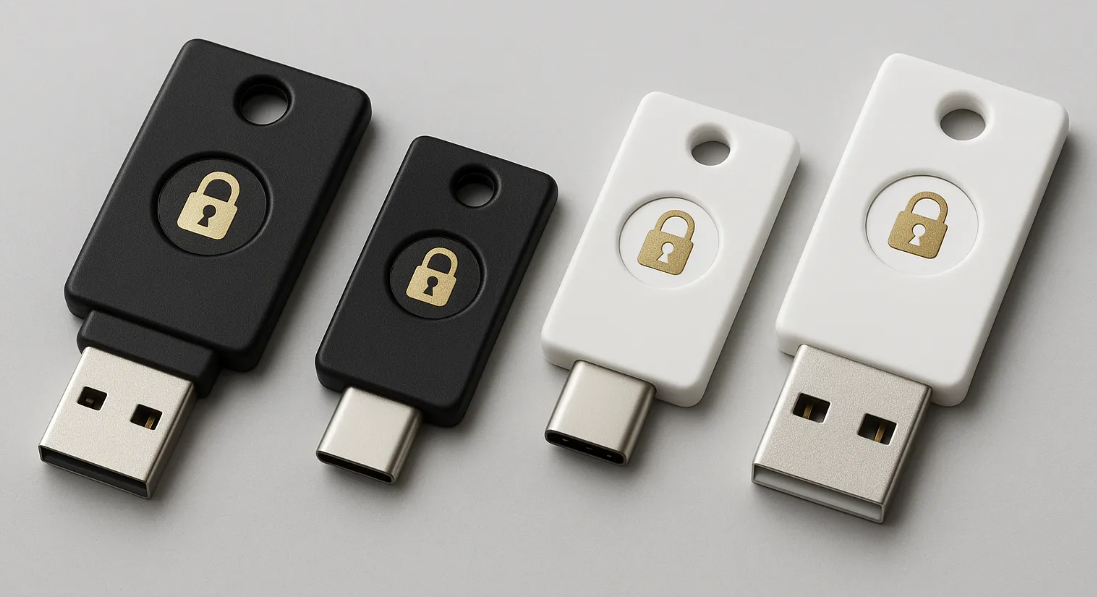
A hardware-backed passkey keeps the cryptographic credential protected by a dedicated physical security device. Examples include hardware authenticators and smart cards from vendors such as HID and Hirsch.
The private key is generated and
protected within the hardware's secure environment rather than being treated as a credential that needs to synchronize across a user's personal devices.The user must physically possess the authenticator to authenticate. Physical possession becomes part of the security model.
Why Does Hardware Matter?
Think about your house. You could give someone a digital code that can be stored, copied, synchronized, and recovered through another system. Or you could require a physical key. Both can open the door, but they create very different security models.
A hardware-backed passkey is essentially putting the cryptographic "key" behind a physical security boundary. An attacker who steals a username and password doesn't have the physical authenticator. An attacker who compromises a user's email account doesn't automatically have the physical authenticator. An attacker who tricks a user into visiting a fake login page can't simply ask the hardware authenticator to authenticate to the attacker's website, because FIDO authentication is designed to bind the credential to the legitimate relying party.
And importantly, the private cryptographic key isn't simply sitting in a password manager database waiting to be copied.
Ready to Move Beyond Passwords?
If your organization is evaluating FIDO2, passkeys, phishing-resistant MFA, converged credentials, or hardware-based authentication, Tx Systems can help you evaluate the right credential architecture for your environment.
Don't just make authentication passwordless. Make it harder to steal.
Explore hardware-backed passkeys and converged credentials with Tx Systems. Check out our
Passkey page here!